3 min read
Sisal or natural hair? Choosing a dandy brush
Why we moved the 8-Piece Kit’s dandy brush to sisal in Version 2, and how to tell which bristle your horse’s coat needs.
By Masiel Spark

The dandy brush is the hard brush in a grooming kit: the one that comes after the curry comb and sweeps away the mud, dried sweat and dust it brought to the surface. How well it does that job depends almost entirely on its bristles.
In the first version of our 8-Piece Kit, the dandy brush had natural hair bristles. In Version 2 we changed them to natural sisal. Here is why — and how to choose between the two for your own horse.
What a rider told us
We read every review of our kits. One of them, about the first version of the 8-Piece Kit, said this:
“…it could really benefit from one stiffer brush to get dirt out.”
It was a fair point. A kit built for the full routine needs one brush that can deal with a really dirty coat. So for Version 2 we gave the dandy brush stiffer bristles: natural sisal. You can read that review, and every other one, on our reviews page.
Sisal: stiff and hard-working
Sisal is a natural plant fibre, made from the leaves of an agave. It is much stiffer than hair, so it gets down to the dirt in fewer strokes. On the Version 2 dandy brush, the sisal is cut flat at 2.5 cm and set in a beechwood body with a leather hand strap.
Sisal is the better choice when:
your horse lives out or comes in muddy;
you need to lift dried sweat after work;
the coat is thick, especially in winter.
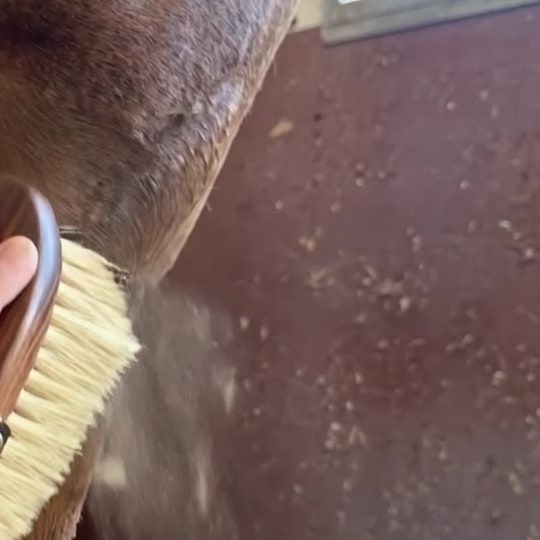
Natural bristles: firm, with more give
Natural bristles are softer and more flexible than sisal. The dandy brush in our 4-Piece Set uses longer natural bristles — 6 cm — and is still the stiffest brush in that set. It lifts mud and dried dirt with a little more give, and it also works at bath time.
A natural-bristle dandy brush suits:
horses with fine or clipped coats and thin skin;
horses that are sensitive to a stiff brush;
coats that are dusty more than muddy, as in summer.
How to tell what your horse needs
Watch your horse, not the brush. If a few firm strokes leave the coat clean and your horse stands relaxed, the brush is right. If dried mud is still there after several passes, you need something stiffer. If your horse flinches, swishes its tail or steps away, go softer or lighter.
Whichever you choose, the technique is the same:
short, firm strokes in the direction of the hair;
a flick of the wrist at the end of each stroke, to lift the dirt off the coat instead of pushing it back in;
body, neck and legs only — never the face. For the face, use a soft face brush.
Use the curry comb first, so the dandy brush has loose dirt to sweep away.
Looking after it
Sisal and natural bristles are cared for the same way: knock the brush out after each use, wash only the bristles now and then, and dry it bristles-down. Our guide to cleaning natural-bristle brushes has the full routine.
Not sure which kit fits your horse? Compare the kits or ask us.
